 Homecare App
Home care software built for Maine Medicaid EVV.
Maine routes EVV through Sandata (OpenEVV Alt-EVV). Homecare App captures every Medicaid visit with GPS clock-in and clock-out, coded reasons and an audit trail, and its Sandata connector is built to the published specification — the certification is completed with your agency as the sponsoring provider, at no cost to you.
Built for how Maine actually receives EVV
Maine agencies live inside two sets of rules: MaineCare (Office of MaineCare Services)'s, and Sandata's. The software was built to both — the state's EVV requirements in the visit record, Sandata's interface in the connector — so the agency does the work once and the aggregator gets it in its own format. Open model.
- ProgramMaineCare (Office of MaineCare Services)
- Servicespersonal care, home health and waiver services under MaineCare
- Serving agencies inPortland, Lewiston–Auburn, Bangor, Augusta and the Midcoast
One aggregator: Sandata's OpenEVV interface
Three endpoints, one order
Clients, then employees, then visits, each posted as JSON and polled to completion before the next — the appendix's own rule. The software does exactly that, and reads each record's verdict back into the visit.
Certified once per state
A vendor registers with Sandata, receives UAT credentials under a sponsoring provider in the state, passes the interface test, and is then on file for every later agency in that state.
The addendum decides the codes
Which identifier a caregiver is known by (SSN or a custom ID), which the client is, the payer and program IDs, the reason-code table and the ID formats all come from the state's addendum — and live on the account, not in code.
Maine specifics
Sandata Alt-EVV integration with a minimum eight-week onboarding; GPS must be enabled, exceptions cannot be altered, and the vendor must have a process for exceptions and rejected records.
What Sandata wants, and where the app gets it
Every element the state names, the record it comes from in the app, and where it lands.
| Element | Where the app gets it | Where it lands |
|---|---|---|
| Client record | Medicaid ID as the addendum spells it, name, home address with coordinates | clients endpoint |
| Employee record | Caregiver by SSN or custom ID per the addendum; position; NPI where the state asks | employees endpoint |
| Visit record | VisitOtherID, PayerID / PayerProgram, HCPCS + up to four modifiers, UTC times | visits endpoint |
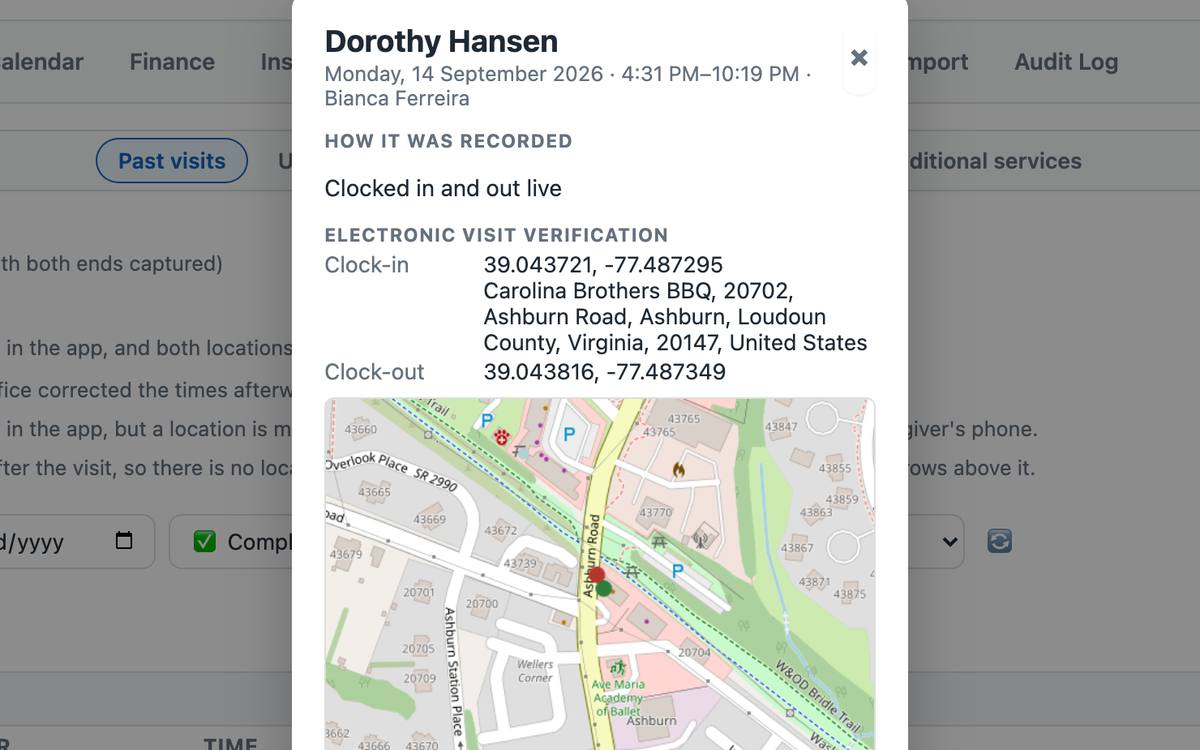
| Calls | Mobile with latitude/longitude, or Telephony with the originating phone | Calls[] |
| Manual or corrected visit | VisitChanges with the program's ReasonCode and a memo | VisitChanges[] |
| Sequence | A timestamp SequenceID that only ever rises, so a resend is an update | SequenceID |
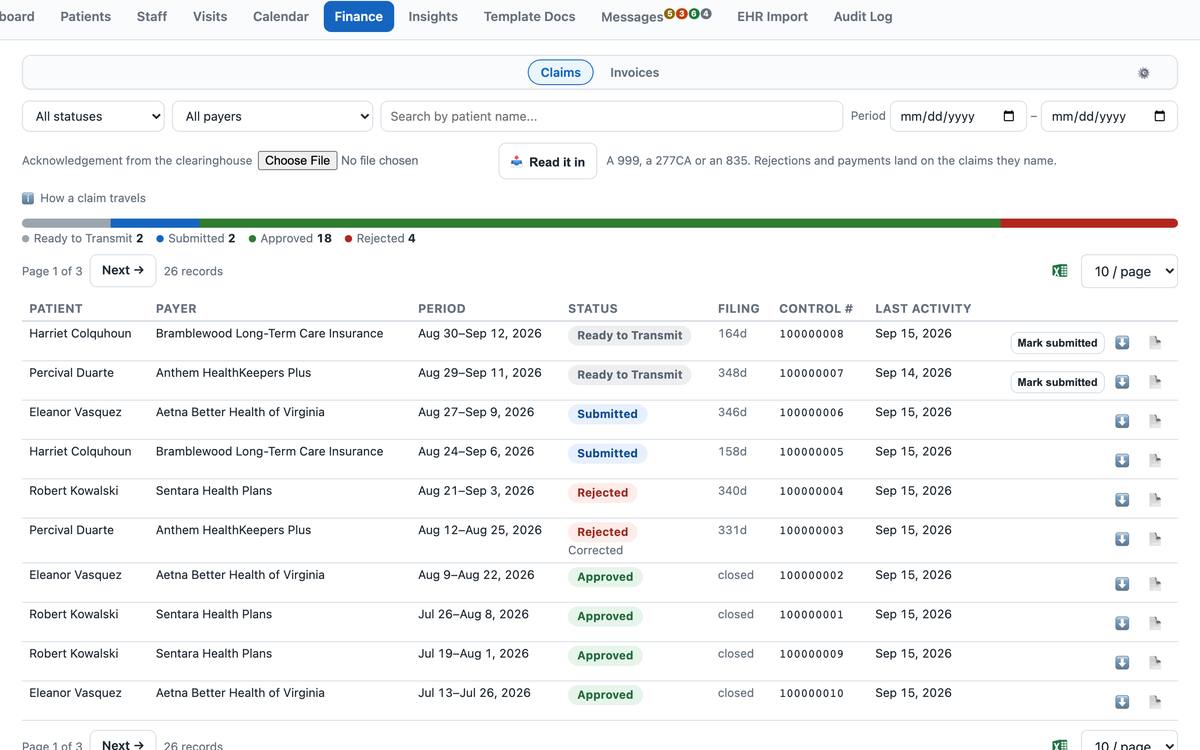
| Verdict | Status polled by transaction id; per-record errors read back to the visit | /status?uuid= |
What the office and the caregiver actually see
Your first month in Maine
Want to see this on your own visits? Twenty minutes on a screen-share, in Maine's format.
Book the demoEVV is one tab. The software runs the whole agency.
Questions Maine agencies ask
Do our caregivers have to use Sandata's app?
No. Sandata's app is the state's free option; an agency with its own system sends visits into the same aggregator through the Alt-EVV interface. Caregivers use one app — this one — and the state gets the same data.
What does the certification involve?
Sandata issues UAT credentials under a sponsoring provider in the state, we send clients, employees and visits to their test environment, work through their checklist, and they confirm. We do this with your agency as the sponsor, at no cost to you; the software is already built and tested against the published specification.
What if the state changes its reason codes or payer IDs?
Those are settings on the aggregator account, not code. When an addendum is revised the account is updated and the next send carries the new values.
Can we start before the certification is done?
Yes. Scheduling, documents, billing and the caregiver app work from day one, and every Medicaid visit is captured with GPS and coded reasons. Visits queue for the aggregator and go the day the account is live — nothing is re-entered.
Which Maine programs does this cover?
Personal care, home health and waiver services under MaineCare — every service MaineCare (Office of MaineCare Services) requires EVV for. Sandata Alt-EVV integration with a minimum eight-week onboarding; GPS must be enabled, exceptions cannot be altered, and the vendor must have a process for exceptions and rejected records.
The Maine documents this page is written from
Read the state's own words; the page above is our summary of them as of 2026-09-21.
- Office of MaineCare Services — Electronic Visit Verificationwww.maine.gov
- Medicaid.gov — EVV under the 21st Century Cures Actwww.medicaid.gov
- Homecare App — the Cures Act EVV requirement, explainedfirstsupport-emr.com
EVV, state by state
Five states take EVV from the agency directly; the rest route it through a contracted aggregator. The 51-state EVV map has the model and where the software stands in each.
Also on Sandata: California, Colorado, Connecticut, Delaware, District of Columbia, Hawaii, Idaho, Indiana, Massachusetts, Missouri, Nevada, Ohio, Rhode Island, Vermont, Wisconsin
See a visit go from clock-in to the Sandata queue.
Twenty minutes on a screen-share: clock-in, clock-out, and the Sandata record for that visit. If it is not a fit you will know in five.