 Homecare App
Home care software built for South Carolina Medicaid EVV.
South Carolina routes EVV through HHAeXchange (EVV Data Aggregator API). Homecare App captures every Medicaid visit with GPS clock-in and clock-out, coded reasons and an audit trail, and its HHAeXchange connector is built to the published specification — the certification is completed with your agency as the sponsoring provider, at no cost to you.
Built for how South Carolina actually receives EVV
South Carolina agencies live inside two sets of rules: South Carolina Department of Health and Human Services's, and HHAeXchange's. The software was built to both — the state's EVV requirements in the visit record, HHAeXchange's interface in the connector — so the agency does the work once and the aggregator gets it in its own format. Open model with HHAeXchange (replaced the closed AuthentiCare / Care Call system).
- ProgramSouth Carolina Department of Health and Human Services
- ServicesHCBS waivers (CLTC, DDSN) and home health
- Serving agencies inColumbia, Charleston, Greenville–Spartanburg, Myrtle Beach and Rock Hill
One aggregator: the HHAeXchange Data Aggregator API
A REST API with a token
OAuth client credentials, a caregiver record, visits in batches of up to a hundred, and a transactions endpoint that gives each visit its verdict. Members come from the payer's feed; the visit names them by Medicaid ID.
Ten published test cases
HHAeXchange publishes its interface test: authenticate, create and update a caregiver, five visits in a batch, one visit, a missed visit, an edit, a delete, and two that must fail. The software passes all ten against a faithful mock today, and runs them against the real implementation environment with one command.
Edits and missed visits carry codes
A corrected time carries the state's edit reason and action codes; a cancelled scheduled visit can be reported as a missed visit with its own codes.
South Carolina specifics
HHAeXchange EDI/API integration meeting SCDHHS requirements. The state was under CMS penalties for late EVV in 2024–26, so expect strict enforcement.
What HHAeXchange wants, and where the app gets it
Every element the state names, the record it comes from in the app, and where it lands.
| Element | Where the app gets it | Where it lands |
|---|---|---|
| Caregiver | providerTaxID, qualifier and identifier (NPI or custom), name, hireDate, licence | caregivers endpoint |
| Visit | office, member (MedicaidID), caregiver, payerID, procedure code and modifiers, UTC schedule and visit times | visits endpoint |
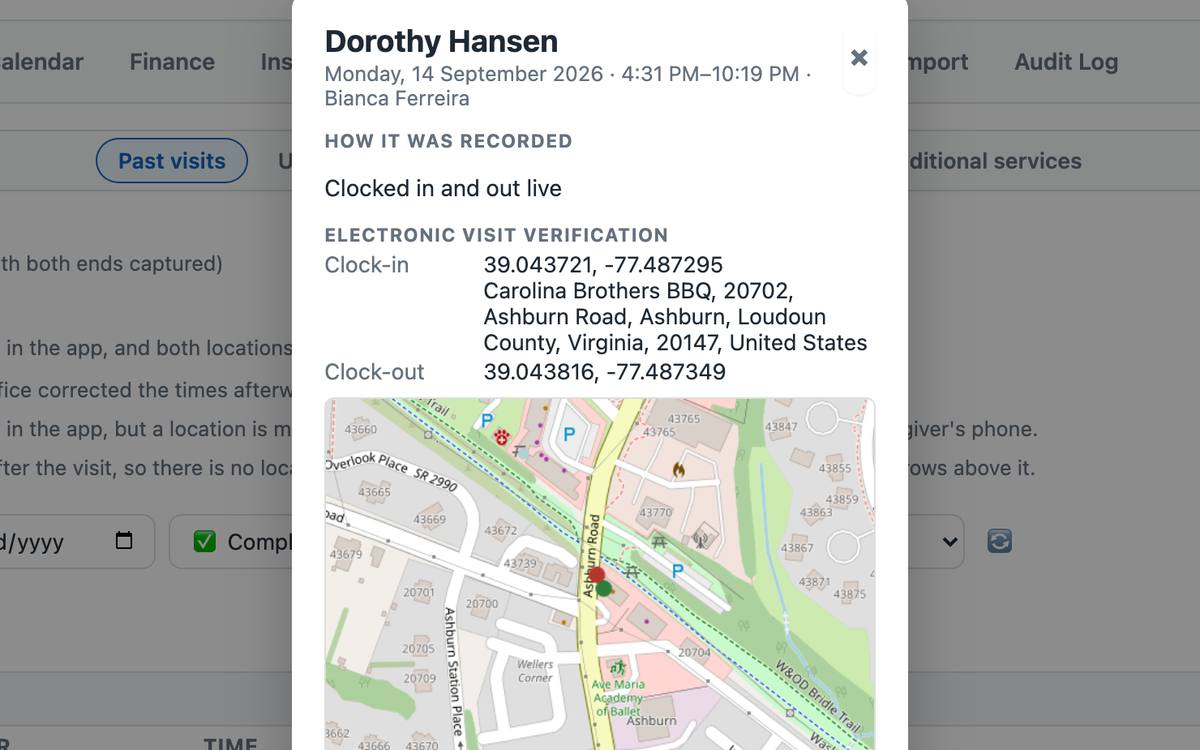
| Clocks | clockIn / clockOut with call type, coordinates or originating phone, service address | evv{} |
| Edit | edited = true with reason and action codes and a note | editVisit{} |
| Missed visit | missed = true with reason and action codes | missedVisit{} |
| Identity | Our external visit id with the '~' prefix, so a resend updates rather than duplicates | evvmsId |
| Verdict | Transaction status per visit, at most five reads a second | transactions endpoint |
What the office and the caregiver actually see
Your first month in South Carolina
Want to see this on your own visits? Twenty minutes on a screen-share, in South Carolina's format.
Book the demoEVV is one tab. The software runs the whole agency.
Questions South Carolina agencies ask
Do our caregivers have to use HHAeXchange's app?
No. The free HHAeXchange app is the state's default; an agency with its own system sends the same visits into the aggregator through the API. Caregivers use one app.
What does the certification involve?
HHAeXchange issues implementation credentials and test patients under a sponsoring provider, we run their ten published test cases, and they review their logs before issuing production credentials. We do this with your agency as sponsor, at no cost to you.
Do we still have to use HHAeXchange for billing?
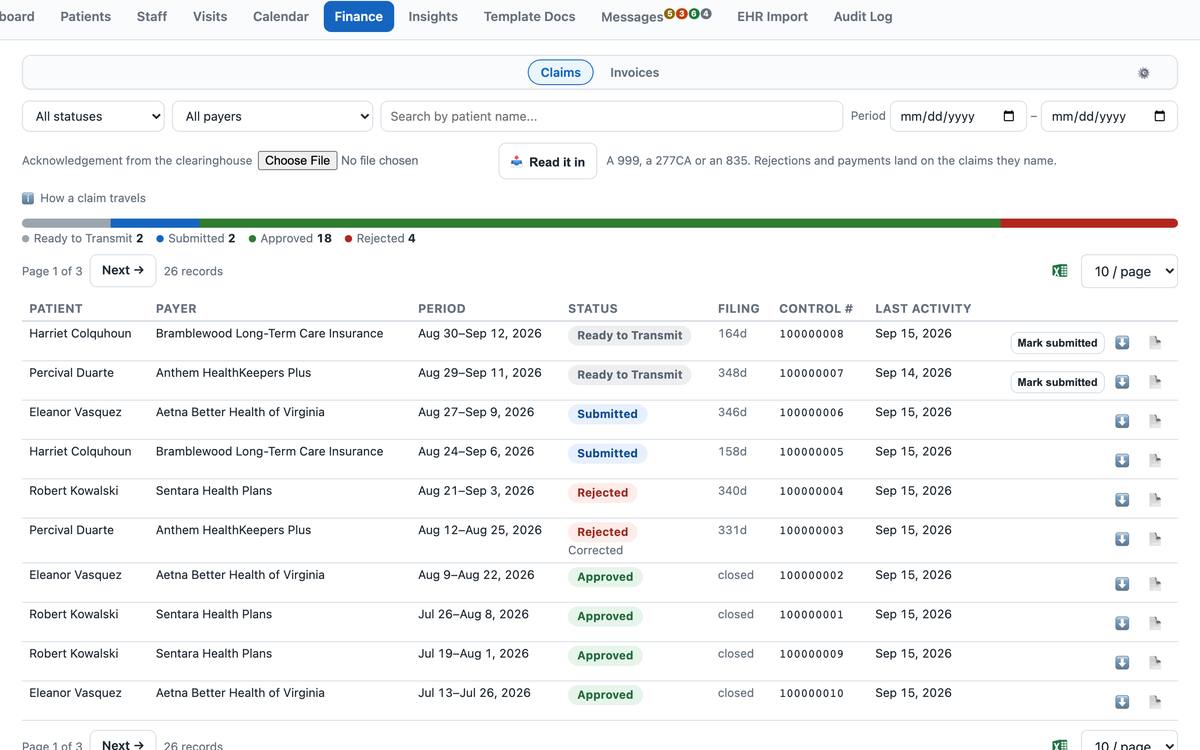
That depends on the state: some route claims through HHAeXchange, most do not. In every case the visit record the aggregator holds is the one the claim is checked against, and this software produces both.
Can we start before the certification is done?
Yes. Scheduling, documents, billing and the caregiver app work from day one; Medicaid visits queue for the aggregator and go the day the account is live.
Which South Carolina programs does this cover?
HCBS waivers (CLTC, DDSN) and home health — every service South Carolina Department of Health and Human Services requires EVV for. HHAeXchange EDI/API integration meeting SCDHHS requirements. The state was under CMS penalties for late EVV in 2024–26, so expect strict enforcement.
The South Carolina documents this page is written from
Read the state's own words; the page above is our summary of them as of 2026-09-21.
- SCDHHS — Electronic Visit Verification launch noticewww.scdhhs.gov
- Medicaid.gov — EVV under the 21st Century Cures Actwww.medicaid.gov
- Homecare App — the Cures Act EVV requirement, explainedfirstsupport-emr.com
EVV, state by state
Five states take EVV from the agency directly; the rest route it through a contracted aggregator. The 51-state EVV map has the model and where the software stands in each.
Also on HHAeXchange: Alabama, Illinois, Michigan, Minnesota, Mississippi, New Jersey, West Virginia
See a visit go from clock-in to the HHAeXchange queue.
Twenty minutes on a screen-share: clock-in, clock-out, and the HHAeXchange record for that visit. If it is not a fit you will know in five.