 Homecare App
Home care software that sends every visit to eMedNY itself.
New York's Choice Model has no state-mandated vendor. The provider — or its system — sends each visit to eMedNY's EVV API, and that is the obligation to the state. Homecare App is that system: it sends, reads back what eMedNY rejected and why, and keeps a per-visit ledger of every transaction.
Built for how New York actually receives EVV
New York put the responsibility on the provider and the plans put a second copy of the requirement on top. An agency in the city can owe the same visit to eMedNY and to an MLTC plan's aggregator on the same day. Homecare App treats that as routing, not extra work: the visit closes once, and each destination gets it in its own format with its own answer kept.
- ProgramNew York State Department of Health Medicaid, eMedNY, and the MLTC and mainstream managed-care plans
- Servicespersonal care services (PCS), CDPAP and home and community-based services billed to eMedNY and to MLTC plans
- Serving agencies inNew York City, Long Island, Westchester and the Hudson Valley, Buffalo, Rochester, Syracuse and Albany
An API, per visit, with the answers kept
The eMedNY EVV Data API
Built to the Interface Control Document v1.4: a batch POST of visits, per-visit rejections keyed by transaction ID, PUT to update one visit, test and production hosts, an API key from the eMedNY developer portal. Keys expire every six months without notice — the app warns on age.
Fields that bite
The member's 8-character CIN must pass the check digit; the date of birth must match eMedNY; the taxpayer ID is the nine-digit FEIN; a procedure code or rate code is required; timestamps are local and never in the future. Each is checked before the send.
Home or Community, with evidence
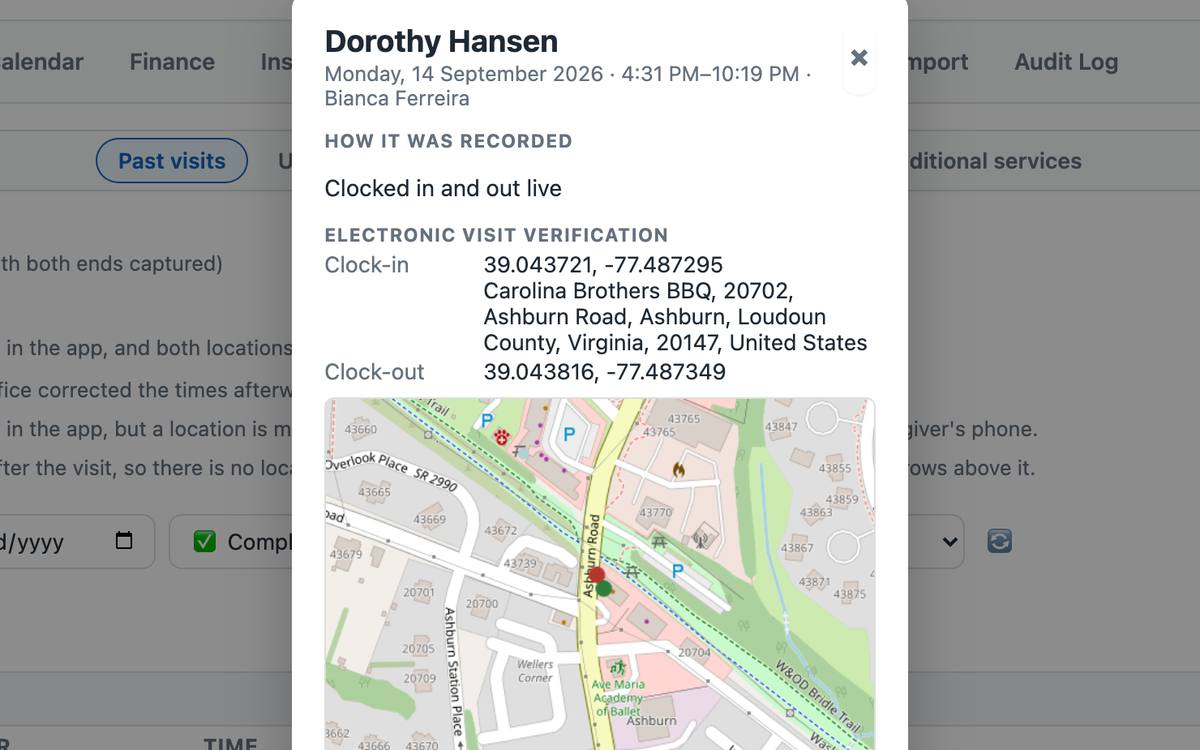
eMedNY does not take GPS; it wants the service location as Home or Community. The app compares the clock-in coordinates with the member's geocoded address to answer, and keeps the coordinates as the evidence behind the answer.
Your MCOs too
A plan may separately want the same visits in its own aggregator. HHAeXchange and CareBridge connectors are built; each plan is a payer row pointed at its aggregator, and the visit goes to both.
What the ICD asks for, and where the app gets it
Every element the state names, the record it comes from in the app, and where it lands.
| Element | Where the app gets it | Where it lands |
|---|---|---|
| memberId | 8-character CIN, check digit verified | Insurance panel |
| dateOfBirth | Must match eMedNY | Patient record |
| taxPayerId / providerId or NPI | Nine-digit FEIN; MMIS id or NPI | Claims settings |
| procedureCode or providerRateCode | From the authorization | Insurance panel |
| serviceStart / serviceEnd | Local time, server-stamped | Clock-in / clock-out |
| serviceStart/EndLocation | Home or Community, derived from GPS vs. the member's address | Computed |
| transactionId | A stable UUID per visit, reused on every resend | EVV ledger |
| Manual visits | Reason and note on any typed or corrected time | Audit trail |
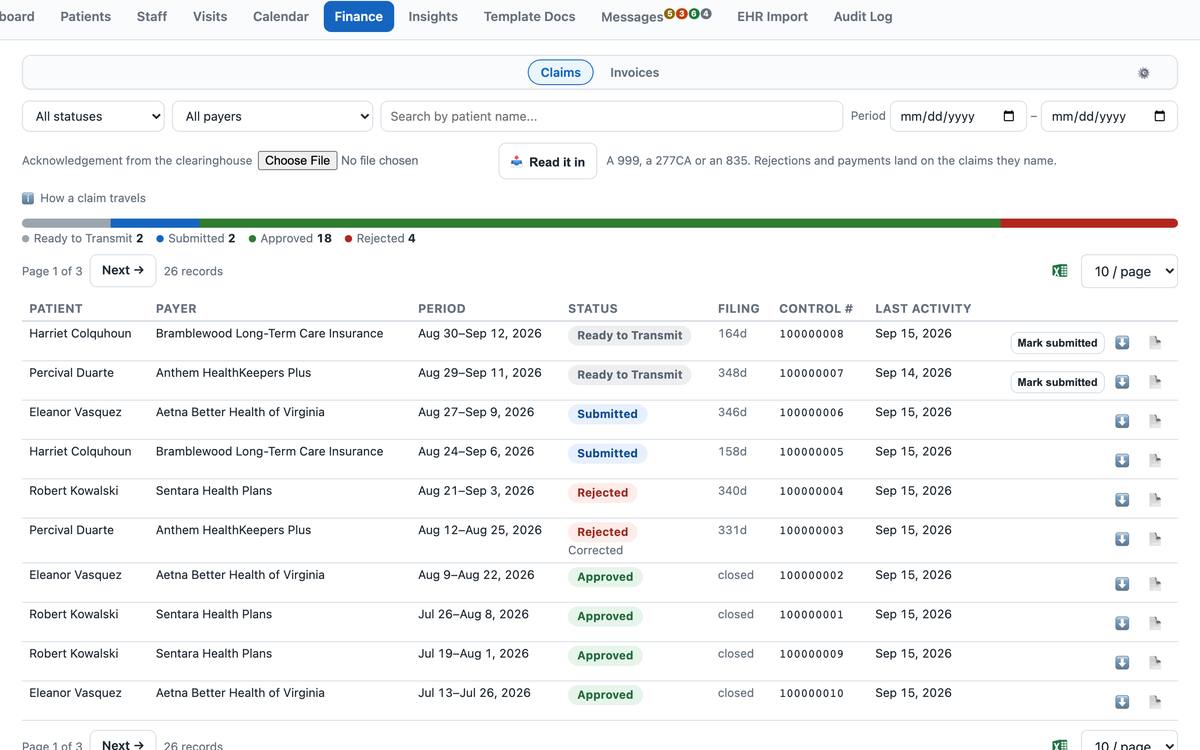
What the office and the caregiver actually see
Your first month in New York
Want to see this on your own visits? Twenty minutes on a screen-share, in New York's format.
Book the demoEVV is one tab. The software runs the whole agency.
Questions New York agencies ask
Does New York require a specific EVV vendor?
No. Under the Choice Model the provider picks its system; the requirement is that visits reach eMedNY's EVV aggregator through its API. Homecare App sends them directly, so there is no third party between you and the state.
What does eMedNY reject most?
In our testing, a CIN that fails the check digit, a date of birth that does not match, and a visit whose end time is in the future. All three are checked before the send, so the batch does not go out with a known rejection in it.
Do we need GPS if the state does not take it?
Yes — it is how the app decides Home versus Community honestly, and it is the evidence behind that answer if a plan or auditor asks. Coordinates stay on the visit; eMedNY receives the word.
Does the API key really expire?
Every six months, with no notice from eMedNY, and a key for one environment is refused by the other. The State EVV page shows the key's age and warns before it lapses.
The New York documents this page is written from
Read the state's own words; the page above is our summary of them as of 2026-09-21.
- eMedNY — Electronic Visit Verificationwww.emedny.org
- NYS Department of Health — EVV programwww.health.ny.gov
- Medicaid.gov — EVV under the 21st Century Cures Actwww.medicaid.gov
EVV, state by state
Five states take EVV from the agency directly; the rest route it through a contracted aggregator. The 51-state EVV map has the model and where the software stands in each.
See a visit reach eMedNY's test environment, live.
Twenty minutes on a screen-share: clock-in, clock-out, the send, and the per-visit answer. No obligation.