 Homecare App
Home care software that writes the Utah UEVV file for you.
Utah Medicaid takes EVV as a CSV uploaded to its own portal — no vendor, no aggregator. Homecare App records every visit the way the UEVV Technical Specifications describe and produces the upload file per billing cycle, including the test submission the state requires before production.
Built for how Utah actually receives EVV
Utah's model is refreshingly direct: follow the specification, pass one test upload, and submit. What trips agencies up is the detail — date formats, leading zeroes on the provider ID, a visit that runs a minute past 24 hours. Homecare App checks each rule before the file is written, so the portal accepts the batch the first time and the office is not re-typing corrections with receipt IDs.
- ProgramUtah Medicaid (Department of Health and Human Services, Office of Long Term Services and Supports)
- Servicespersonal care, respite and attendant care under the Aging Waiver, New Choices Waiver and state-plan home and community-based services
- Serving agencies inSalt Lake City, Provo–Orem, Ogden, St. George, Logan and the Wasatch Front
A state portal, a CSV, and rules that are easy to get wrong
The state runs the portal
Utah Medicaid's Office of Long Term Services and Supports takes EVV at evv.medicaid.utah.gov — a CSV per batch, or a SOAP feed. The app writes the CSV to the spec's Table 4, in the spec's column order, with the spec's element names.
Formats the spec pins down
Dates M/D/YYYY, times 24-hour with seconds, member ID nine or ten digits, provider ID as PRISM or NPI with at most five leading zeroes, coordinates or street at each end, nothing in the future, nothing older than a year. Each rule is enforced before the file is written.
A test upload first
Since October 2023 a submitter must pass a test submission (the portal's 'Data is for Testing Purposes' box) before production access. The app's first export is that test file.
Corrections that match
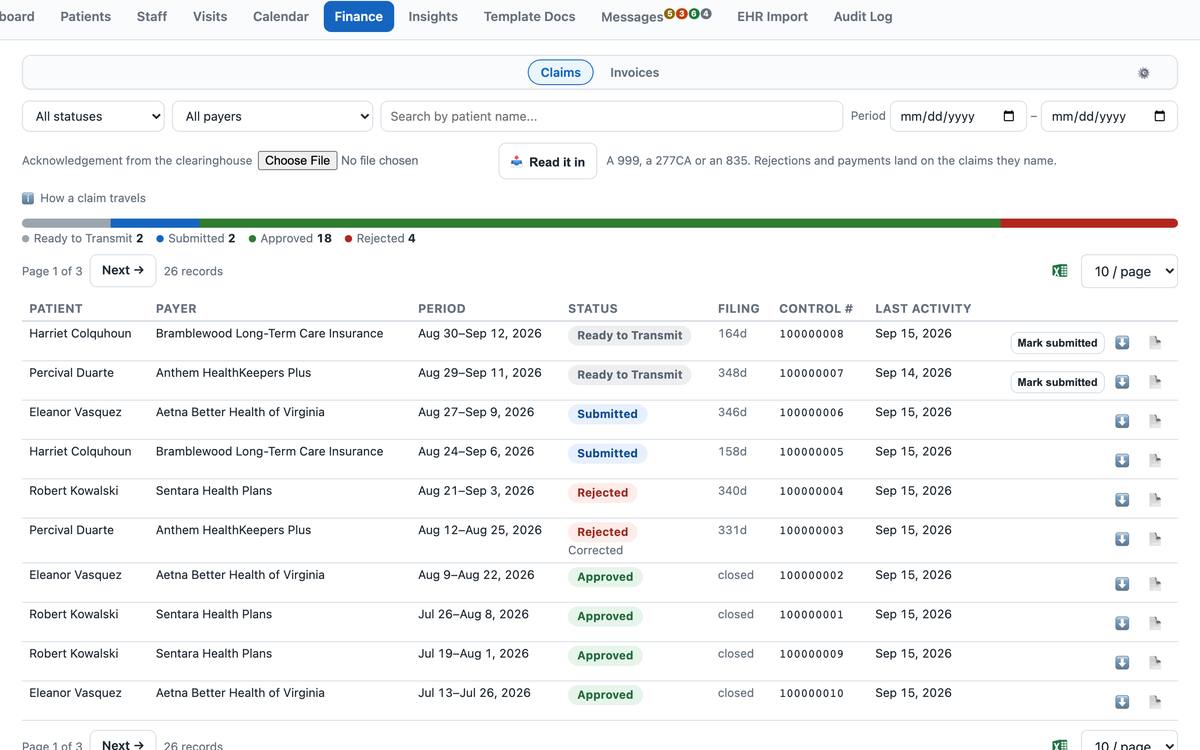
A corrected visit quotes the portal's Receipt ID and the original Batch and Record IDs. The app uses the visit's own id as Record ID and the export date as Batch ID, so a re-export of the same visit resubmits it with the same identity.
What UEVV asks for, and where the app gets it
Every element the state names, the record it comes from in the app, and where it lands.
| Element | Where the app gets it | Where it lands |
|---|---|---|
| Member ID | Nine or ten digits from the patient's Insurance panel | Table 4 |
| Provider ID | PRISM ID (preferred) or NPI, 4–12 digits | Claims settings |
| Service code | HCPCS from the authorization | Insurance panel |
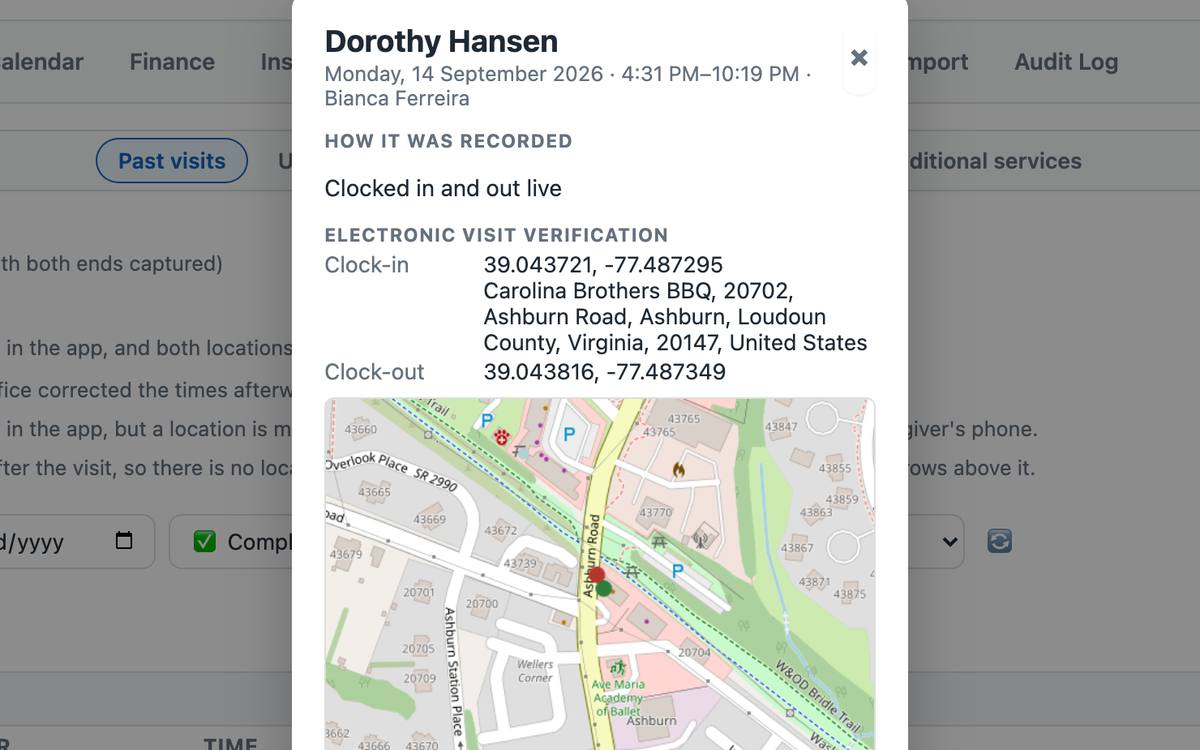
| Start / end date and time | Server-stamped clock-in and clock-out | M/D/YYYY · H:M:S |
| Start / end location | GPS at both ends; street and city added when known | Either is accepted |
| Caregiver | Name and the app's stable caregiver ID | Table 4 |
| Batch ID / Record ID / Receipt ID | Export date, visit id, and the portal's receipt on corrections | §3 portal channel |
What the office and the caregiver actually see
Your first month in Utah
Want to see this on your own visits? Twenty minutes on a screen-share, in Utah's format.
Book the demoEVV is one tab. The software runs the whole agency.
Questions Utah agencies ask
Does Utah require a certified EVV vendor?
No. Utah's model is a state portal that accepts a CSV or SOAP feed from any system that follows the UEVV Technical Specifications. The only gate is the test submission, which the app produces.
Is the CSV header important?
The portal ignores the header row and reads columns by position, so column order is what matters. The app writes the spec's order and the spec's element names; compare against the portal's downloadable template on first use and you will see they match.
What if a visit crosses midnight or runs over 24 hours?
The spec caps a visit at 24 hours and rejects anything in the future or older than a year. The app flags those before export instead of letting the portal reject the batch.
Can we send by SOAP instead of the portal?
The CSV channel is what is built today; it covers every element the SOAP channel does. If your volume ever justifies the automated feed, that is a transport change on our side, not a change to how your staff work.
The Utah documents this page is written from
Read the state's own words; the page above is our summary of them as of 2026-09-21.
- Utah Medicaid — Electronic Visit Verificationmedicaid.utah.gov
- UEVV portal — secure web submissionevv.medicaid.utah.gov
- Medicaid.gov — EVV under the 21st Century Cures Actwww.medicaid.gov
EVV, state by state
Five states take EVV from the agency directly; the rest route it through a contracted aggregator. The 51-state EVV map has the model and where the software stands in each.
See the UEVV file come out of a real visit.
Twenty minutes: a caregiver clocks in and out, the month exports, the CSV opens next to the state template. No obligation.