 Homecare App
Home care software that fills the OHA EVV reporting template every month.
Oregon Health Authority does not run an aggregator for home health. Each month the agency sends a spreadsheet of every completed visit to OHA within ten days of month end. Homecare App writes that file — in the template's columns, in the template's order, with OHA's two quirks handled.
Built for how Oregon actually receives EVV
Oregon asks for less ceremony than most states and more precision: one spreadsheet a month, in a format with two rules no other state has. An agency that builds it by hand does it wrong once, then spends the next month reconciling. Homecare App writes the template from the visits that actually happened, converts the coordinates, splits the overnight visits, and leaves the office with a file to attach.
- ProgramOregon Health Authority (OHA) and the Oregon Department of Human Services (ODHS) Aging and People with Disabilities
- ServicesMedicaid home health under OAR 410-127 and in-home care and personal support services under ODHS/APD
- Serving agencies inPortland, Salem, Eugene, Bend, Medford and the Willamette Valley
A monthly template, e-mailed — with two rules nobody else has
The OHA template, as a CSV
The Home Health EVV Reporting Instructions (OHA HSD) define the columns. The app writes them by name and in order, so the office opens the file, saves it as .xlsx if the mailbox insists, and sends it to [email protected].
Degrees, minutes, seconds
OHA wants coordinates as degrees, minutes and seconds rather than the decimal degrees every phone records. The app converts at export; the caregiver never sees it.
Overnight visits on two lines
A visit that crosses midnight is reported as two lines, one per date, exactly as the instructions say. The app splits it at export and keeps one visit in the record.
Reason codes in OHA's words
A manual or corrected time carries OHA's own code — ProvCICOF, ProvNIC, ProvFOB, ProvMESIC and the rest — mapped from the everyday reason the caregiver picked.
What the template asks for, and where the app gets it
Every element the state names, the record it comes from in the app, and where it lands.
| Element | Where the app gets it | Where it lands |
|---|---|---|
| Provider Medicaid ID | The agency's OHA provider number | Claims settings |
| Member ID | From the patient's Insurance panel | Template column |
| Service and date | HCPCS from the authorization; one line per date | Template column |
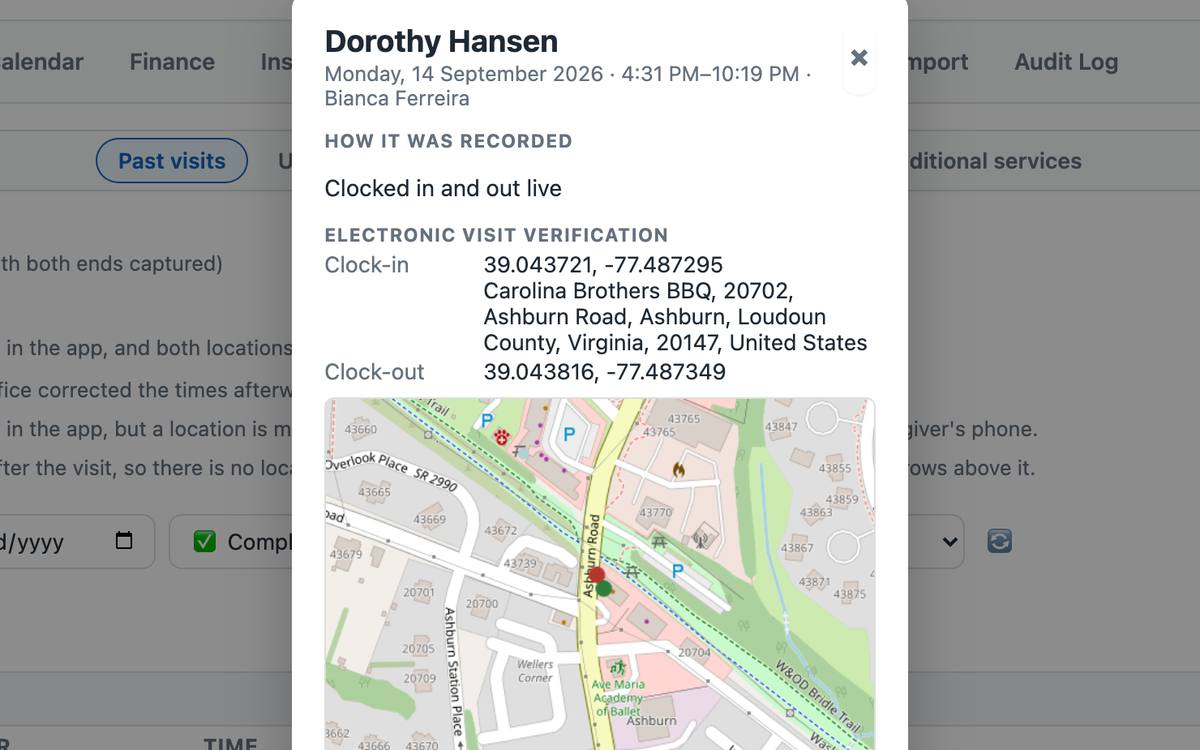
| Start / end time | Server-stamped clock-in and clock-out | Template column |
| Start / end location | Phone GPS, converted to degrees-minutes-seconds | Template column |
| Caregiver | Name and stable ID | Template column |
| Manual-entry reason | OHA's Prov* code and the note | Template column |
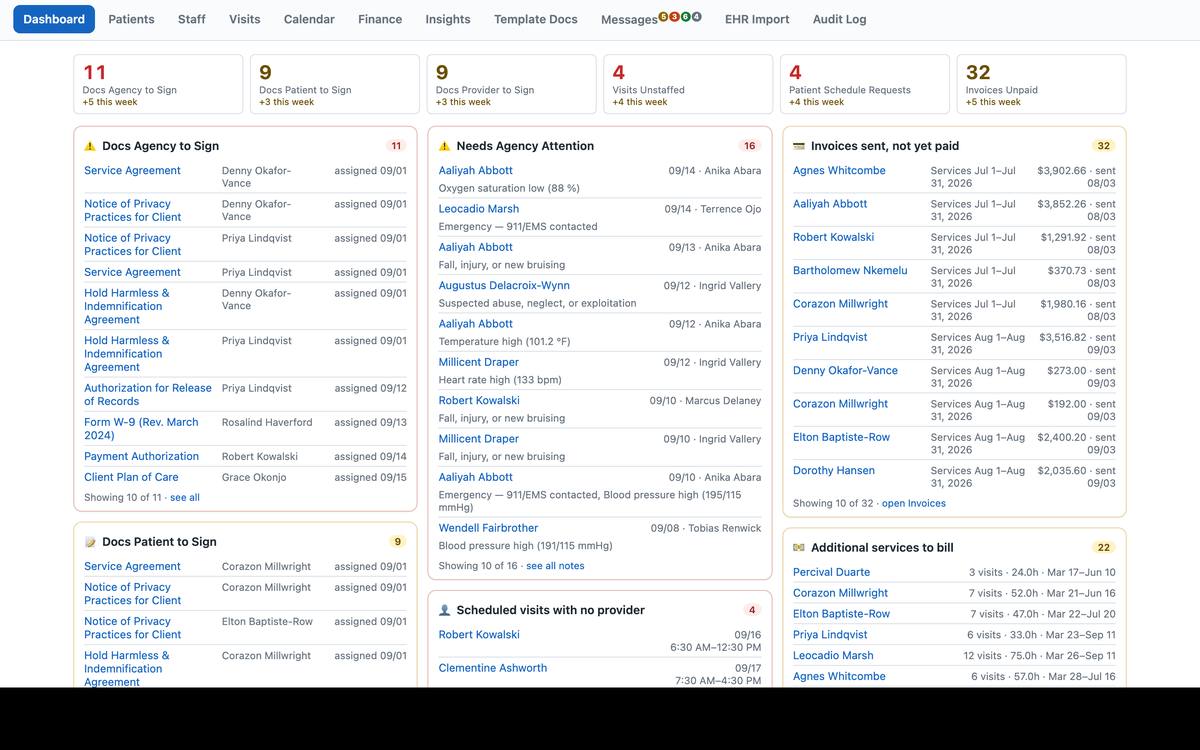
What the office and the caregiver actually see
Your first month in Oregon
Want to see this on your own visits? Twenty minutes on a screen-share, in Oregon's format.
Book the demoEVV is one tab. The software runs the whole agency.
Questions Oregon agencies ask
Is this for home health or in-home care agencies?
The export is built to OHA's Home Health EVV Reporting Template (OAR 410-127-0046). Oregon's in-home care agencies under APD (OAR 411-033) have not been given a published file format yet; if that is you, talk to us — the visit data is captured the same way and we will build to the format when ODHS publishes one.
Does Oregon require a certified EVV vendor?
Not for home health. OHA takes the monthly template from the agency directly; there is no aggregator and no certification. The obligation is the file, complete and on time.
Why degrees, minutes and seconds?
Because the OHA instructions ask for them. It is the one state that does, and it is exactly the kind of detail an agency gets wrong once and then re-sends. The app converts at export.
What if the template changes?
The columns are data in the app, not something a caregiver types. When OHA updates the instructions we update the export; your staff keep clocking the same way.
The Oregon documents this page is written from
Read the state's own words; the page above is our summary of them as of 2026-09-21.
- OHA — Home Health EVV Reporting Instructions (PDF)www.oregon.gov
- OHA — EVV requirements for home health agencies (PDF)www.oregon.gov
- OAR 410-127-0046 — Electronic Visit Verificationwww.law.cornell.edu
EVV, state by state
Five states take EVV from the agency directly; the rest route it through a contracted aggregator. The 51-state EVV map has the model and where the software stands in each.
See a month of visits become the OHA file.
Twenty minutes: clock-in, clock-out, the monthly export opened next to the OHA template. No obligation.