 Homecare App
Home care software built for Virginia Medicaid EVV.
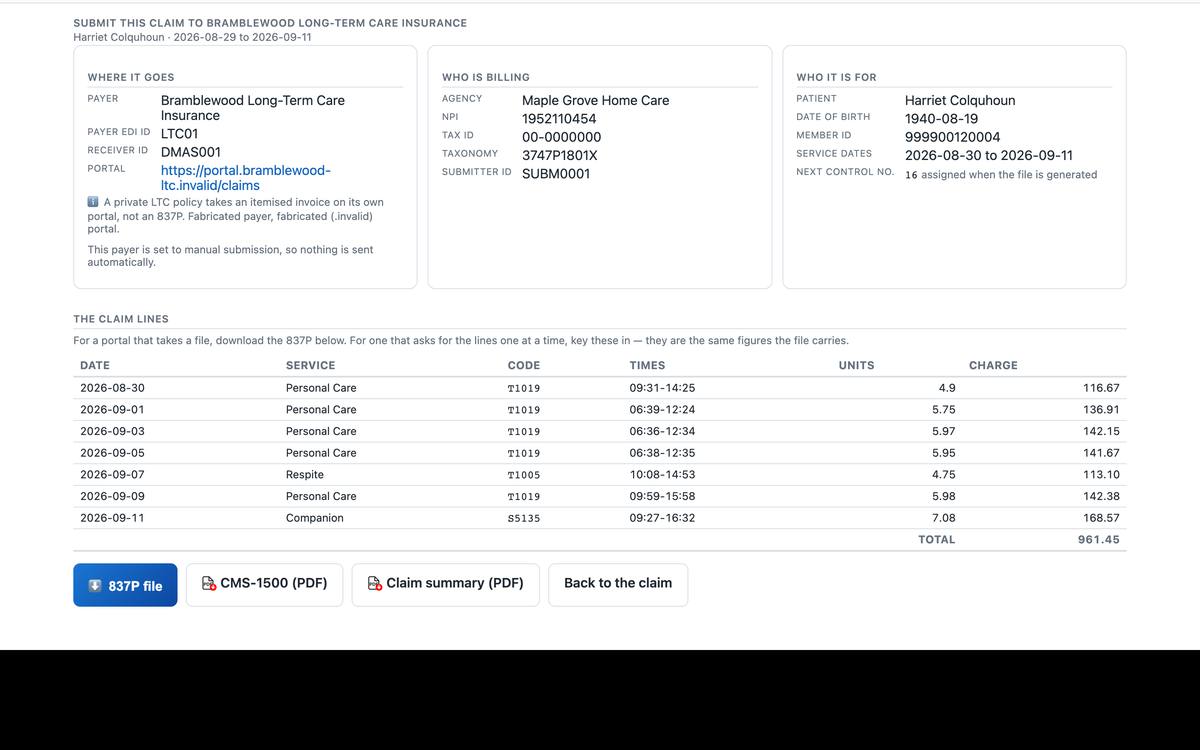
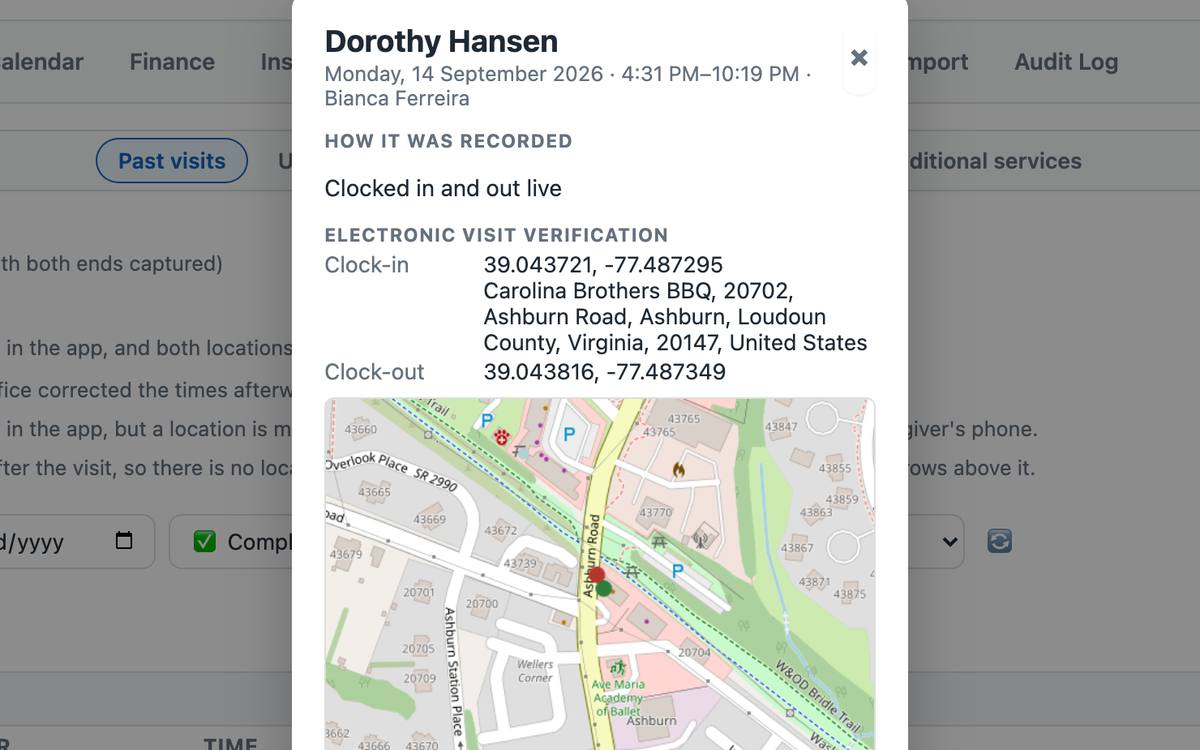
Virginia has no EVV aggregator. DMAS reads the six EVV elements straight off the 837P claim you already send, and denies a personal-care line that is missing them. Homecare App puts them there on every line — GPS clock-in, the caregiver's attendant ID, the visit's begin and end location — so the claim is the compliance.
Built for how Virginia actually receives EVV
A Virginia home care agency lives inside DMAS's rules and five Cardinal Care plans' portals. Homecare App was built by a Northern Virginia agency for exactly that: the EVV data sits on the claim the way DMAS's 837P companion guide describes, the claims come out per plan, and the acknowledgements come back in. There is no aggregator to pay, no vendor to certify with, and no second system for caregivers to learn.
- ProgramVirginia Medicaid (DMAS) and the Cardinal Care managed-care plans
- Servicesagency-directed and consumer-directed personal care, respite and companion services under the CCC Plus and DD waivers
- Serving agencies inNorthern Virginia, Richmond, Hampton Roads, Charlottesville, Roanoke and the Shenandoah Valley
The claim is the EVV submission
No aggregator, no certification
DMAS says it plainly: Virginia does not use the term aggregator. The Medicaid Enterprise System takes the EVV data on the claim itself — 837P for personal care, respite and companion services. There is no vendor to register with and no test environment to pass.
Hard edits since 2020
Personal-care claim lines have been hard-edited since September 2020: a line without the visit's times, location and attendant is denied, not warned. The software cannot let a caregiver skip a step, and it does not.
Five MCOs, one file
Cardinal Care plans each take the same 837P. Build the batch, download the submission pack, upload it in the plan's portal or drop it on your clearinghouse — and read the 999 and 277CA acknowledgements back into the claim.
October 1, 2026
The live-in caregiver exemption ends. From that date every attendant, live-in or not, clocks in and out electronically. The app already treats every Medicaid visit that way; nothing changes on the day.
What DMAS requires, and where the app puts it
Every element the state names, the record it comes from in the app, and where it lands.
| Element | Where the app gets it | Where it lands |
|---|---|---|
| Type of service | The service line's HCPCS and modifier from the patient's authorization (T1019, S5150 …) | Loop 2400 SV1 |
| Individual receiving the service | The member's Medicaid ID on the claim | Loop 2010BA |
| Date of service | The visit date, one line per visit | Loop 2400 DTP*472 |
| Location of service | The patient's home address, as the visit's begin and end location | Loops 2420G / 2420H |
| Individual providing the service | The attendant's unique ID (never SSN or FEIN) | Loop 2400 REF*LU |
| Time the service begins and ends | Server-stamped clock-in and clock-out, GPS at both ends | Loop 2400 DTP time span |
| Manual visits | A coded reason and a note when a time is typed or corrected; original device times kept write-once | Audit trail + EVV report |
The agency that built it runs on it
Homecare App was written inside First Support Home Care, a licensed home care agency in Ashburn, Loudoun County, Virginia, to run its own operation: scheduling, caregiver onboarding, GPS-verified Medicaid visits and Cardinal Care MCO claims, every day. It was built to DMAS's rules because the people building it were being paid under them.
- Licensed in VirginiaA Loudoun County home care agency serving Northern Virginia, not a software company guessing at the rules.
- Bills the MCOs from itThe 837P with the EVV loops is the claim the agency itself files, so the format is exercised on real payers.
- Same product, same loginCustomers run the same software the agency runs, on their own separate instance and database.
What the office and the caregiver actually see
Your first month in Virginia
Want to see this on your own visits? Twenty minutes on a screen-share, in Virginia's format.
Book the demoEVV is one tab. The software runs the whole agency.
Questions Virginia agencies ask
Does Virginia require an EVV vendor or aggregator?
No. DMAS's own FAQ says Virginia does not use an aggregator; the EVV data elements travel as fields on the 837P (personal care) or 837I (home health) claim to DMAS or the MCO. Homecare App writes those fields on every personal-care line, so no separate vendor, registration or certification step exists.
What happens if a caregiver forgets to clock out?
The visit shows as open until it is closed by hand with a coded reason (forgot to clock, device failure, no signal, service in the community …) and a note. The original device times are kept unchanged, the correction is logged, and the EVV report counts it in the manual-entry rate DMAS expects agencies to watch.
What about live-in caregivers?
Virginia's live-in exemption ends October 1, 2026. After that every attendant's visit must be clocked electronically — the app with location on, or the phone line with a PIN. The app already requires that for every Medicaid visit, so there is nothing to switch on.
Can we bill all the Cardinal Care MCOs from it?
Yes. Each plan is a payer row with its own IDs and submission method. The 837P is the same file for all of them; what differs is where it goes — a plan portal, Availity, Office Ally or Waystar — and the app produces the submission pack for whichever you use.
We also do skilled home health. Does this cover the 837I?
Personal care, respite and companion services are this product. Skilled home health (RN, PT, OT) with its 837I and OASIS lives in our nurse portal, which shares the same patient list. Ask about both on the call.
The Virginia documents this page is written from
Read the state's own words; the page above is our summary of them as of 2026-09-21.
- DMAS — Electronic Visit Verificationwww.dmas.virginia.gov
- DMAS — EVV definitions (the six data elements)www.dmas.virginia.gov
- Medicaid.gov — EVV under the 21st Century Cures Actwww.medicaid.gov
EVV, state by state
Five states take EVV from the agency directly; the rest route it through a contracted aggregator. The 51-state EVV map has the model and where the software stands in each.
See a Virginia claim built with its EVV loops, live.
Twenty minutes on a screen-share: a caregiver clocks in, the visit closes, the 837P line comes out with the DMAS fields on it. If it is not a fit you will know in five.