 Homecare App
Home care software that files the ProviderOne claim with EVV on it.
Washington has no aggregator. DSHS and HCA put the EVV elements on the ProviderOne social-service claim, and since 2026 ProviderOne denies a line missing the times, the GPS or the caregiver's SSSOP ID. Homecare App writes the .dat batch file with all of it.
Built for how Washington actually receives EVV
In Washington the EVV rule and the billing rule are the same rule: ProviderOne denies the line. That makes the .dat file the whole game, and it is an unforgiving one — a caret in a note, a nine-digit authorization, a caregiver not yet rostered. Homecare App builds the line exactly to HCA's format specification and refuses to build one it knows will be denied, naming the visit and the missing piece instead.
- ProgramWashington Medicaid (Apple Health) — DSHS Aging and Long-Term Support Administration and the HCA ProviderOne system
- ServicesMedicaid Personal Care, COPES and other home and community-based waiver services billed as social-service claims
- Serving agencies inSeattle, Tacoma, Spokane, Vancouver, Bellevue, Everett and the Tri-Cities
The claim edits are the EVV enforcement
Three edits that deny
Edit 32010 (start and end time), 32020 (start and end coordinates) and 32040/32041 (the servicing caregiver's SSSOP ID) all deny the line. The app cannot build a line without them and says which visit is short.
Every caregiver rostered
The SS Servicing-Only ProviderOne ID is issued per caregiver once you roster them in ProviderOne. It sits on the caregiver's profile and rides on every line they serve.
The .dat batch, exactly
One claim line per line of text, 33 fields, carets between and a tilde at the end; dates mmddyyyy, times hhmmss, signed decimal coordinates; ten-digit authorization numbers; whole 15-minute units; one line per date per service per caregiver per authorization.
Manual Claims Indicator
A typed or corrected time carries the indicator from the EVV Systems Requirements Guide, mapped from the reason the caregiver or office chose.
What ProviderOne wants on a social-service line
Every element the state names, the record it comes from in the app, and where it lands.
| Element | Where the app gets it | Where it lands |
|---|---|---|
| Client ID | The ProviderOne client id | Insurance panel |
| Provider ID | Nine-digit ProviderOne id (7 + 2-digit location) | Claims settings |
| Authorization number | Ten digits, from the patient's authorization | Insurance panel |
| Service code and units | HCPCS/modifier and whole 15-minute units (8-minute rule) | Computed per visit |
| Start / end time | hhmmss, server-stamped | Edit 32010 |
| Start / end latitude and longitude | Five decimal places from the phone at each end | Edit 32020 |
| Servicing caregiver SSSOP ID | From the caregiver's profile | Edits 32040 / 32041 |
| Manual Claims Indicator | From the reason code | EVV Requirements Guide §3 |
What the office and the caregiver actually see
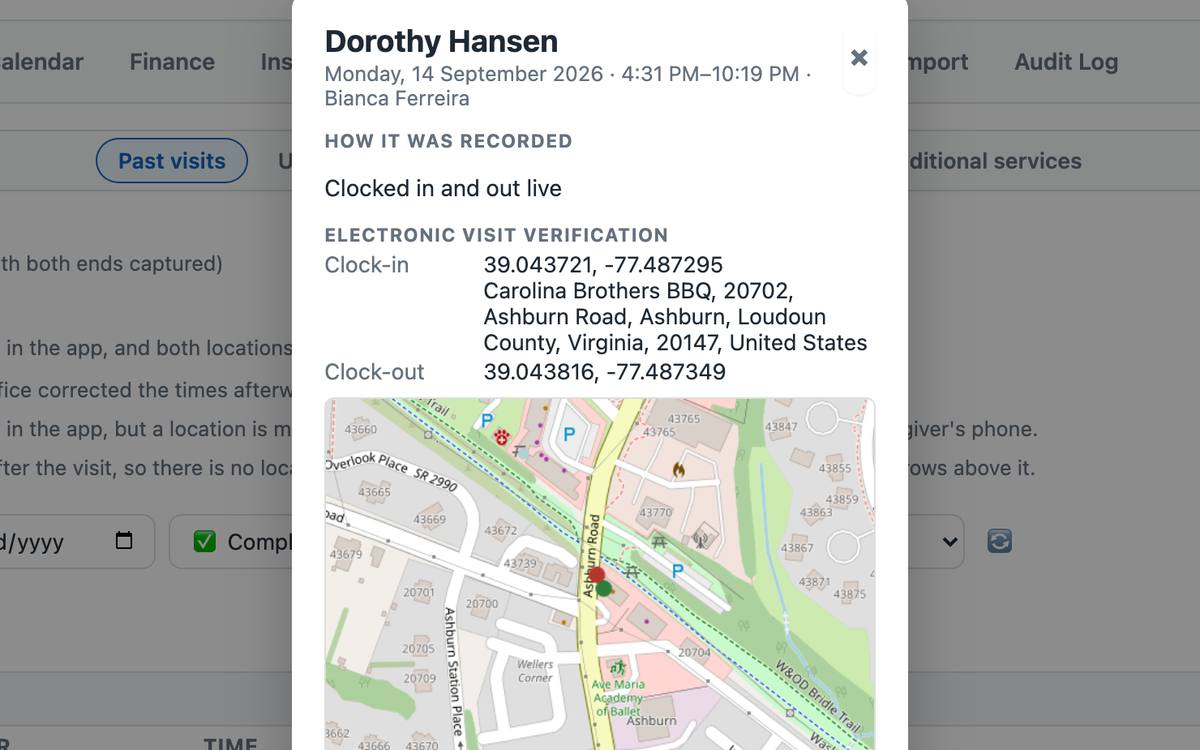
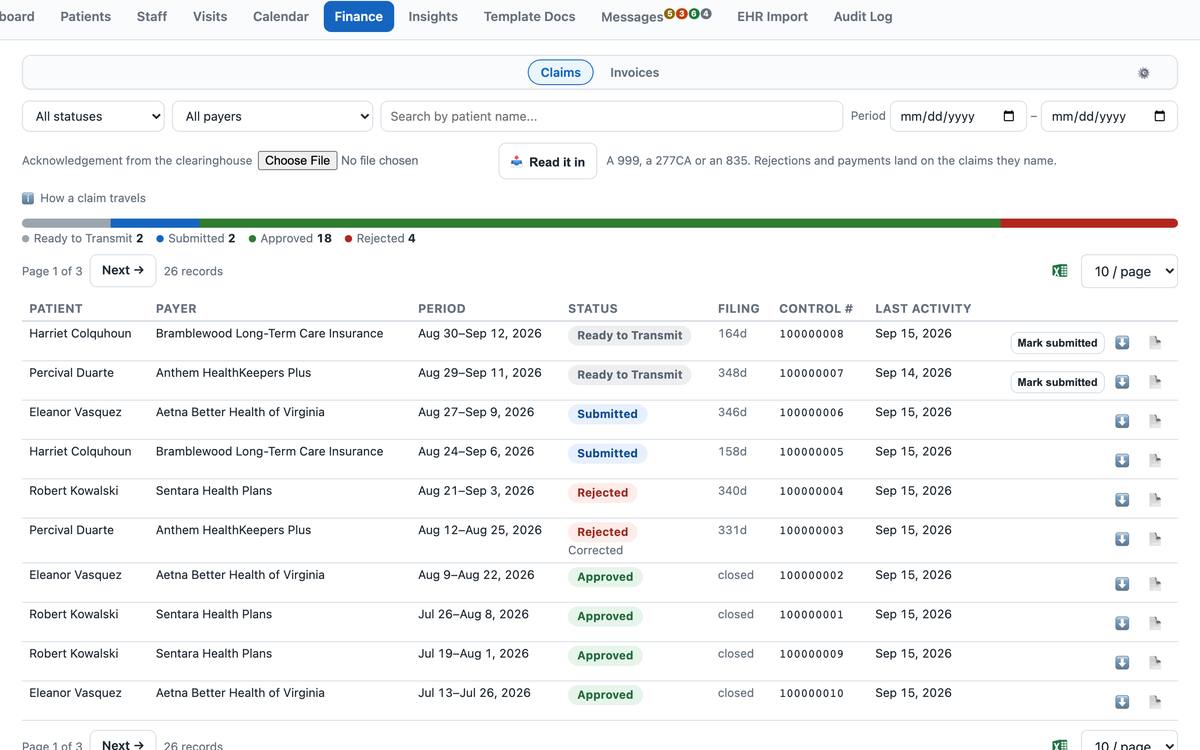
Your first month in Washington
Want to see this on your own visits? Twenty minutes on a screen-share, in Washington's format.
Book the demoEVV is one tab. The software runs the whole agency.
Questions Washington agencies ask
Is there an EVV aggregator or vendor certification in Washington?
No. For home care agencies the EVV data goes on the ProviderOne social-service claim, and ProviderOne's own claim edits enforce it. There is nobody to certify with; there is a file to get right, and this app gets it right.
What is an SSSOP ID and why does the app insist on it?
The SS Servicing-Only ProviderOne ID identifies the individual caregiver on the claim line. ProviderOne denies a line without it (edits 32040/32041), so the app will not build a line for a caregiver whose profile has none, and tells you who.
Do we still need GPS if the caregiver uses the phone line?
A telephony clock records the caller ID instead of coordinates. Washington's edit 32020 wants coordinates on the line, so the app uses the client's geocoded home address for a landline visit and flags a visit that has neither.
Can it produce adjustments and voids?
Yes — claim frequency 7 and 8 lines quote the parent TCN. The original submission is kept, so a correction is a new line, not an edit to history.
The Washington documents this page is written from
Read the state's own words; the page above is our summary of them as of 2026-09-21.
- DSHS ALTSA — Home Care Agency EVV Resourceswww.dshs.wa.gov
- DSHS ALTSA — Electronic Visit Verificationwww.dshs.wa.gov
- HCA — EVV Systems Requirements Guide (PDF)www.hca.wa.gov
EVV, state by state
Five states take EVV from the agency directly; the rest route it through a contracted aggregator. The 51-state EVV map has the model and where the software stands in each.
See a ProviderOne line built from a real clock-in.
Twenty minutes on a screen-share: clock-in, clock-out, the .dat line next to the HCA specification table. No obligation.